| Vietnam News Today (Mar. 9) notable headlines Vietnam reaffirms commitment to promoting nuclear disarmament, non-proliferation OV intellectuals in Europe step up AI cooperation with Vietnam Ho Chi Minh City exhibition highlights Vietnam-Laos-Cambodia solidarity Vietnam emerging as a new engine of global economic growth Vietnam is second most attractive investment destination: Survey Vietnam Festival 2026 in Osaka spreads Vietnamese culture Vietnamese NA helps build institutional foundations for long-term development: Canadian researcher Vietnamese Embassy in Israel advises citizens to comply with host country’s guidelines Ho Chi Minh City aims for additional 30,000 social housing units for workers by 2030 |
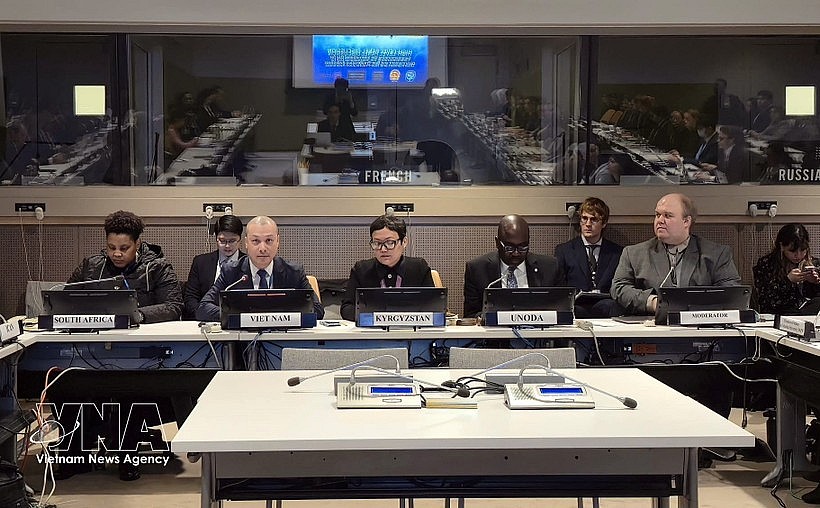 |
| Minister-Counselor Nguyen Hoang Nguyen, Chargé d’Affaires ad interim of the Permanent Mission of Vietnam to the United Nations (second, left), speaks at the debate. (Photo: VNA) |
Vietnam reaffirms commitment to promoting nuclear disarmament, non-proliferation
Minister-Counselor Nguyen Hoang Nguyen, Chargé d’Affaires ad interim of the Permanent Mission of Vietnam to the United Nations, has reaffirmed Vietnam’s strong commitment to promoting nuclear disarmament and preventing the proliferation of nuclear weapons, highlighting the importance of multilateral cooperation and dialogue in addressing global security challenges.
Addressing a recent debate marking the International Day for Disarmament and Non-Proliferation Awareness in New York co-hosted by the Permanent Missions of Vietnam and Kyrgyzstan to the UN, Nguyen expressed his concern over the current international security environment, stressed the importance of advancing disarmament efforts, and called on countries to strengthen solidarity and multilateralism to build trust and shared understanding on this issue.
The Vietnamese representative also reaffirmed the country’s principled stance and strong commitment to these efforts, underscoring its determination to serve as President of the 11th Review Conference (RevCon11) of the Treaty on the Non-Proliferation of Nuclear Weapons (NPT) in a balanced, transparent and inclusive manner.
The discussion, which was co-sponsored and coordinated by the International Campaign to Abolish Nuclear Weapons (ICAN), the Nuclear Age Peace Foundation (NAPF), and Columbia University’s Frontiers of Science Program (FSP), saw the attendance of nearly 100 participants, including representatives from UN agencies, UN member states, scholars and students from universities in New York, VNA reported.
Delegates showed concern over the increasingly complex geopolitical environment and the risks posed by an intensifying arms race and ongoing international conflicts. They stressed the crucial role of global disarmament process and non-proliferation of weapons of mass destruction, including relevant international treaties such as the Treaty on the Non-Proliferation of Nuclear Weapons (NTP) and the Treaty on the Prohibition of Nuclear Weapons (TPNW).
They emphasized the importance of continued dialogue, strengthened cooperation and greater public awareness, especially among young people, about the devastating consequences of nuclear weapons, and the role of multilateral cooperation for efforts to eliminate nuclear threats permanently.
Participants highly valued and expressed their strong support for Vietnam’s upcoming role as President of the RevCon11 of the NPT, scheduled to take place in New York in April - May this year.
In 2022, the 77th session of the UN General Assembly adopted Resolution A/RES/77/51, designating March 5 - the date the NPT entered into force in 1970 - as the International Day for Disarmament and Non-Proliferation Awareness. The resolution aims to raise public awareness of the importance of nuclear disarmament and non-proliferation for international peace and security. It also calls on UN member states, international organizations, the public and the media to mark the day through educational activities and initiatives to raise public awareness.
OV intellectuals in Europe step up AI cooperation with Vietnam
More than 100 scientists, experts and representatives from Vietnamese businesses operating in Belgium and other European countries on March 7 gathered at a workshop on Vietnam–European Union (EU) cooperation in science, technology and trade, focusing on artificial intelligence (AI) applications in many sectors.
Co-organised by the Embassy of Vietnam in Belgium and Luxembourg and the Vietnamese Mission to the EU, in coordination with the Vietnamese Intellectuals Association in Belgium and Luxembourg (ViLaB) and the Vietnam Business Association in Belgium, the Netherlands, Luxembourg (VBAB), the workshop was seen as an important forum connecting Vietnamese intellectuals across Europe to foster cooperation in high-tech sectors, particularly AI.
It featured four in-depth discussion sessions with nearly 20 speakers from Vietnam and Europe, covering AI applications in digital transformation, economic development, trade, energy, nuclear medicine and biotechnology.
In his opening remarks, Vietnamese Ambassador to Belgium Nguyen Van Thao highlighted the flourishing development of the Vietnam – EU relations, as well as the bilateral ties between Vietnam with Belgium and Luxembourg, especially in the fields of trade, investment, climate change adaptation and green development.
He noted that under the joint statement on the Vietnam–EU Comprehensive Strategic Partnership signed in January, science, technology and innovation have been identified as important pillars of cooperation for the coming period.
According to ViLaB President Phung Quoc Tri, as innovation and digital transformation are becoming major drivers of economic growth worldwide, the workshop aimed to foster connections between scientists, businesses and research organizations from Vietnam and the EU, paving the way for future collaborative projects.
VBAB President Nguyen Thanh Vinh said the event marked the first large-scale AI workshop in Europe organised by Vietnamese associations. He noted that many businesses, especially small- and medium-sized enterprises, are keen to adopt AI but lack clear strategies, therefore engagement with experts and researchers could help them identify suitable solutions.
Meanwhile, Dr Nguyen Duy Cu, Vice President of ViLaB, emphasised that stronger international cooperation is essential to improving scientific and technological capacity as AI becomes a major force driving global innovation.
According to the expert, Europe has strong foundations in technology, education and scientific research, while Vietnam benefits from a young, dynamic workforce capable of rapidly adopting new technological trends. Connecting these complementary strengths could significantly boost scientific and technological development, according to VNA.
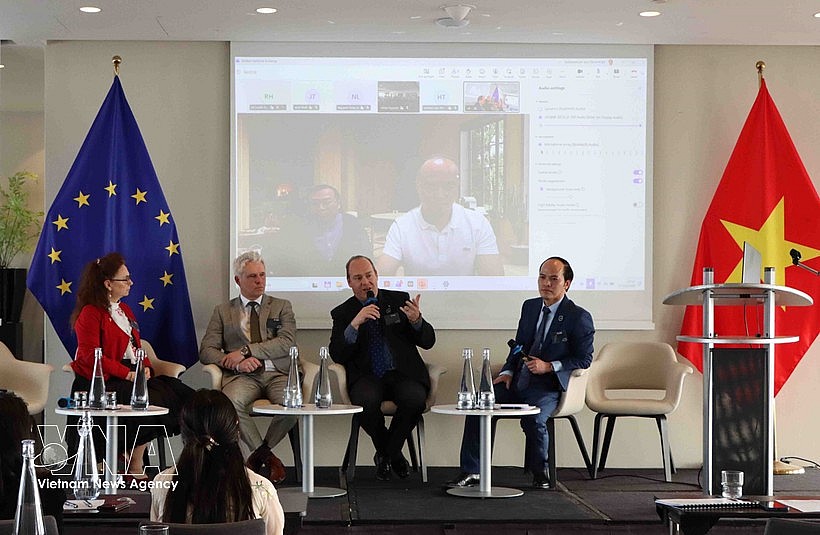 |
| Speakers at an in-depth discussion session (Photo: VNA) |
Speakers also shared technological advances and experiences in research cooperation between Vietnam and Europe.
Prof. Geert Angenon from Vrije Universiteit Brussel (VUB) noted that collaboration with Vietnamese partners in biotechnology could pave the way for a range of cooperative programs between universities and research institutes.
Participants also discussed practical technology applications, including the use of robotics in dairy farming and biotechnology solutions for soil remediation and clean agriculture.
Beyond academic exchanges, the event underscored the increasingly important role of Vietnamese intellectuals in Europe in connecting knowledge, technology and international resources for Vietnam’s development.
Such initiatives are expected to help make science and technology, especially AI - a key bridge for deepening Vietnam–EU relations in the future.
Ho Chi Minh City exhibition highlights Vietnam-Laos-Cambodia solidarity
More than 150 documents, photographs and artifacts highlighting the special solidarity among Vietnam, Laos and Cambodia are being showcased at a thematic exhibition that opened on March 7 at the Lao student dormitory in Xuan Hoa ward, Ho Chi Minh City.
The exhibition, titled “The Special Solidarity and Friendship among Vietnam, Laos and Cambodia,” is jointly organised by the Ton Duc Thang Museum, the municipal Youth Union and the Ho Chi Minh City Union of Friendship Organizations. The event marks the 75th anniversary of the establishment of the united front of the alliance of Vietnamese, Lao and Cambodian people (March 11, 1951 – 2026), while also commemorating the 46th anniversary of the passing of Vietnamese President Ton Duc Thang.
Speaking at the opening ceremony, Pham Thanh Nam, Director of the Ton Duc Thang Museum, said the exhibition aims to recall and honor the tradition of special solidarity among the three countries. This invaluable historical legacy was forged during the struggles for national independence and continues to be preserved and promoted in the cause of national construction and defence in each country today.
Through more than 150 documents, images and artifacts, the exhibition, which will run through March 31, recreates the proud historical journey of the solidarity among the three nations. It also serves as an educational activity to promote revolutionary traditions and foster a spirit of sincere international friendship among younger generations, particularly Lao and Cambodian students currently studying in Ho Chi Minh City, VOV reported.
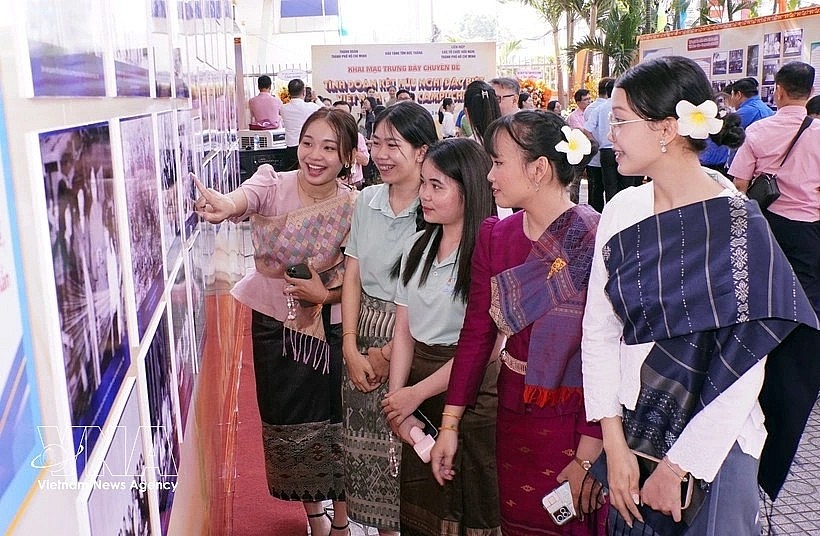 |
| Students visit the exhibition (Photo: VNA) |
Nguyen Thi Thanh Thuy, Deputy Director of the Ho Chi Minh City Department of Culture and Sports, stated that despite changes in the global and regional landscape, the special friendship and solidarity among Vietnam, Laos and Cambodia continue to be strengthened and expanded across various fields, including economy, culture, education, national defence and security.
Ho Chi Minh City has consistently promoted people-to-people exchanges, and traditional education activities and created favourable conditions for Lao and Cambodian students studying in the city, thereby contributing to nurturing the enduring friendship among the three nations, she added.
Vietnam emerging as a new engine of global economic growth
Vietnam is gaining global attention as a fast-growing economy, with strong manufacturing performance, rising investment and deeper participation in global supply chains.
Amid profound changes in global supply chains and trade structures, recent international studies indicate that Asian economies are increasingly emerging as new engines of global growth. Among them, Vietnam has attracted growing attention thanks to its rapid development, deep economic integration, and significant transformation of its production structure.
New projections from the Harvard Growth Lab at Harvard University suggest that Vietnam could become one of the world’s leading economies in terms of per capita GDP growth over the coming decade. According to the study, economies with more diversified and sophisticated production capabilities are expected to play a key role in driving global economic growth in the next phase. In this context, Vietnam and China stand out as countries whose economic complexity is significantly higher than their current income levels.
This measure is captured by the Economic Complexity Index (ECI), which reflects the diversity and technological sophistication of a country’s export products. Economies with higher ECI scores tend to have greater capacity to expand into more complex industries and generate higher value-added activities.
According to Ricardo Hausmann, director of the Harvard Growth Lab, countries capable of expanding into more sophisticated industries will gain a significant advantage in global competition. He noted that amid rising trade tensions and ongoing shifts in global supply chains, advanced manufacturing capacity and deeper participation in international industrial networks are becoming key determinants of long-term economic growth, cited VOV.
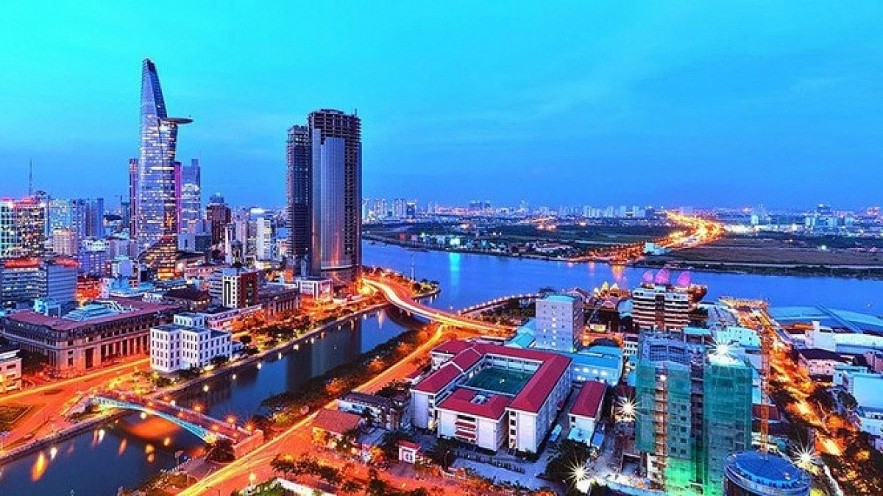 |
| New research suggests Vietnam could lead global growth in per capita GDP in the coming decade, supported by diversified production and ongoing economic reforms. (Illustrative image) |
Recent manufacturing indicators also highlight Vietnam’s positive growth momentum. Data from S&P Global show that the country’s Purchasing Managers' Index for manufacturing reached 54.3 in February, marking the eighth consecutive month of improved business conditions. The report indicates that both factory output and new orders increased, reflecting stable demand from both domestic and international markets.
Alongside the manufacturing sector, Vietnam’s financial market has also expanded significantly in recent years. According to FTSE Russell, the market capitalisation of the FTSE Frontier Vietnam Index rose from approximately US$11 billion in 2015 to about US$59 billion in 2025. Vietnam is also expected to be upgraded to secondary emerging market status in 2026, which could attract additional international investment flows from major global funds.
These positive trends are taking place as Vietnam continues to promote growth model transformation, accelerate industrialization, and enhance science and technology capacity in line with development orientations outlined at the 14th National Congress of the Communist Party of Vietnam.
Ben Blissett, an economic analyst and commentator, noted that over the past years the Communist Party of Vietnam has introduced reforms aimed at improving the business environment and increasing the country’s attractiveness to international investors. According to assessments by the Economist Intelligence Unit, Vietnam’s business environment has improved faster than that of any other country monitored by the organization.
For several decades, Vietnam has pursued a policy of economic openness and international integration. The country joined the Association of Southeast Asian Nations in 1995, signed the Bilateral Trade Agreement with the United States in 2000, and became a member of the World Trade Organization in 2007. These milestones have helped accelerate trade liberalisation and attract foreign direct investment, making Vietnam one of the most open economies in the region.
In addition, Vietnam benefits from a young workforce with a median age of around 33. The country’s education performance has been positively evaluated in international assessments such as the Programme for International Student Assessment, with results close to the average level of countries in the Organization for Economic Co-operation and Development (OECD). A well-trained workforce is widely regarded as a key factor enabling the economy to move gradually toward higher value-added segments in global production chains.
Amid ongoing uncertainties in the global economy, experts believe that Vietnam’s adaptability and continued institutional reforms will remain crucial factors in sustaining the country’s long-term growth momentum.
Vietnam is second most attractive investment destination: Survey
Vietnam is now ranked second among the top three destinations for Asia-Pacific CEOs planning outbound investment, just behind the U.S. and followed by China Mainland.
The PwC Vietnam's newest Global CEO Survey noted that the level of investors' interest in Vietnam has almost doubled in just one year, rising from 8 percent to 15 percent.
The survey noted that as geopolitical volatility, technological disruption and economic recalibration reshape the global landscape, Vietnam is emerging as one of the region's most compelling bright spots.
Vietnam's trajectory – anchored by strong macroeconomic fundamentals, deepening integration into global supply chains and continued regulatory modernisation, positions the country at the center of this regional reinvention, it highlighted.
What stands out in this year's survey is the contrast between regional caution and Vietnam's rising strategic profile. Even as global CEOs recalibrate expectations around growth and performance, Asia-Pacific leaders are signalling renewed confidence in Vietnam as an investment destination, innovation hub and emerging anchor in diversified supply‑chain networks.
As highlighted in the CEO29 Asia-Pacific findings, the nation is positioned for significant outperformance with an actual GDP growth of 8.02 per cent in 2025 while the country sets GDP growth at 10 per cent for period from 2026 to 2030, driven by resilient domestic consumption, planned increases of 20 - 30 per cent in public infrastructure investment and expected 8 per cent export expansion in 2026, even amid global trade tensions.
 |
| Photo: VGP |
According to PwC, Vietnam's continued rise as a regional outlier is also supported by a regulatory environment that is becoming more transparent, predictable and investor‑friendly.
The Investment Law 2025, which took effect on March 1, 2026, is now simplifying administrative procedures, enhancing legal certainty and strengthening investor protections, further bolstering Vietnam's attractiveness to foreign investors and reinforcing long‑term private‑sector competitiveness.
The convergence of economic resilience and regulatory modernisation has created a wave of optimism among investors and business leaders, VGP reported.
Vietnam's export performance remains a cornerstone of its economic strength. Despite facing a 20 per cent U.S. tariff, the country's exports grew 17 per cent in 2025, driven by nearly 28 per cent growth in shipments to the U.S.
To translate Vietnam's growing economic momentum into sustained, long‑term advantage, business leaders must embrace reinvention as a continuous discipline rather than a one‑off initiative. The findings signal a clear inflection point: organizations that outperform are those that move with speed and intention to reshape their business models for an AI‑powered, trust‑driven and rapidly evolving marketplace.
 | Vietnam News Today (Mar. 4): Vietnam Wishes to Lift Ties with Greece to New Level Vietnam News Today (Mar. 4):Vietnam opposes use of force against sovereign nations; Vietnam wishes to lift ties with Greece to new level; Border Guards stand ... |
 | Vietnam News Today (Mar. 5): Vietnamese, Mongolian Courts Deepen Judicial Cooperation Vietnam News Today (Mar. 5): Vietnamese, Mongolian courts deepen judicial cooperation; Slovenia ready to share experience in safe nuclear power development with Vietnam; Vietnamese Trade ... |