
New Technology Aids Search for Fallen Soldiers in Gia Lai
| Gia Lai Allocates Over VND 2.1 Trillion for Safe Housing Projects Gia Lai Seeks to Deepen Economic Cooperation with RoK's Investors |
Recently, the Gia Lai Provincial People’s Committee, in coordination with the Institute of Design under the General Department of Logistics and Technical Affairs of the Ministry of National Defence, conducted a ground-penetrating radar survey in the Xuan Son Hill area of An Nghia Commune. This modern survey method helps identify areas showing anomalies beneath the ground, supporting the search and collection of fallen soldiers’ remains in a more scientific, accurate and effective manner.
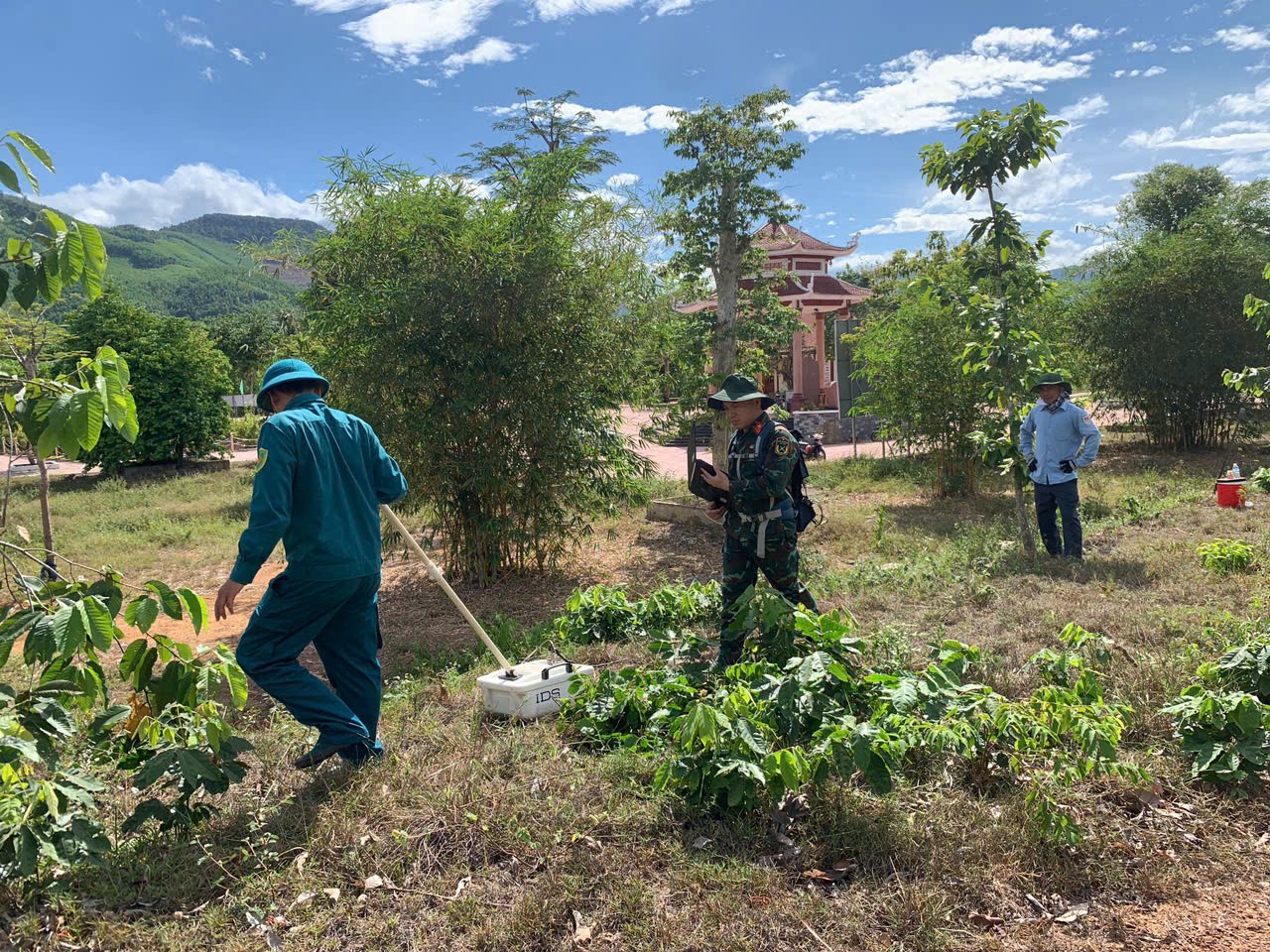 |
| Authorities deploy ground-penetrating radar equipment and specialized personnel to support the search. (Photo: Gia Lai Provincial Military Command) |
At the time, Xuan Son Hill was an important military position. According to recorded documents, US forces stationed an artillery position and infantry units on the hilltop, supported by artillery bases in nearby areas. With terrain favorable for defense and a powerful firepower system, the US side believed that the stronghold would be difficult to attack. On the night of December 26 and early morning of December 27, 1966, the 22nd Regiment launched a surprise attack on the enemy position. The battle was an outstanding military victory, delivering a heavy blow to the US forces’ sweep and pacification strategy in the area.
The battle was extremely fierce. Amid a barrage of bombs and gunfire, soldiers of the 22nd Regiment advanced into the enemy’s position with courage and determination. Many soldiers were struck by “beehive bombs” - weapons containing thousands of small arrows inside the bomb that, upon detonation, created a wide area of destruction. They fell in battle with the bearing of steadfast soldiers, many of them still very young.
Over the years, based on documents and the memories of war veterans, and through connections with historical witnesses, including information provided by a US veteran who once participated in the war in Vietnam, authorities gradually narrowed down areas where a mass grave might be located. In March 2022, the team responsible for searching for and collecting fallen soldiers’ remains in Binh Dinh Province, now part of Gia Lai Province, conducted surveys and exploratory work and discovered a mass burial pit in the Xuan Son Hill area.
The discovery opened a particularly moving chapter. Following the search, dozens of sets of remains, along with numerous wartime artifacts, were found. By comparing historical documents, witness accounts, bone samples and artifacts, the authorities determined that these were the remains of those who had fallen in the attack on the Xuan Son stronghold in late 1966. By April 2022, around 60 fallen soldiers had been commemorated and laid to rest at the Martyrs’ Cemetery in Hoai An Commune, including 51 officers and soldiers of the 22nd Regiment, 3rd “Golden Star” Division.
As part of the 500-Day-and-Night Campaign, the Gia Lai Provincial People’s Committee, in coordination with the Institute of Design, conducted a ground-penetrating radar survey in the Xuan Son Hill area. Based on historical documents, eyewitness information and, in particular, data provided by US veterans, the authorities gradually narrowed down the areas requiring investigation. Among them, an area of approximately one hectare east of the Xuan Son Hill Memorial Stele was identified as a priority area for the survey.
Ground-penetrating radar allows surveys to be conducted beneath the surface, recording signs of anomalies underground. The data collected will provide a basis for specialized teams to conduct further analysis, narrow down locations and identify sites requiring field inspection, thereby helping improve the effectiveness of the search while limiting large-scale excavation.
The search may remain difficult. The traces of the battle may have been buried by time. But every meter of land surveyed, every sign detected and every piece of information verified carries a special meaning: It is a journey to bring those who sacrificed their lives home to their families, their homeland and their comrades. No sacrifice will be forgotten.
 500 People in Gia Lai Province Trained in Disaster Response 500 People in Gia Lai Province Trained in Disaster Response From May 27-30, the International Organization for Migration (IOM) Vietnam, in coordination with the Vietnam Disaster and Dyke Management Authority (VDDMA) under the Ministry of Agriculture and Environment, organized a series of training sessions and disaster response drills in Cat Tien and Ngo May communes, Gia Lai Province, to strengthen community preparedness and response capacity. |
 Gia Lai: Open Quantum, Semiconductor and Superconductor Technology Exhibition Gia Lai: Open Quantum, Semiconductor and Superconductor Technology Exhibition Visitors have the opportunity to experience emerging technologies firsthand and receive advice from experts and businesses on the application of quantum, semiconductor, and superconductor technologies in production and everyday life. |


Most read


Related Stories
 Viets Home
Eight Additional Remains of Fallen Soldiers Discovered at Le Thi Rieng Park
 National
15,401 Fallen Soldiers’ Remains Samples Transported by Military Aircraft
 National
Efforts to Bring Fallen Soldiers Home to Their Families
 Viets Home
Dien Bien Buries Remains of 10 Fallen Soldiers at Tong Khao Martyrs' Cemetery
Recommended
 Viets Home
UAE Culture Comes Alive in Hanoi
 Viets Home
WVI and Dien Bien Chart Next Chapter in Support for Children
 Viets Home
Tuyen Quang: New Space for Reading, Experiential Learning and Career Guidance for Kim Xuyen Students
 Viets Home
Finding Confidence in Learning English
Popular article
 Viets Home
My New Home: An Invitation to Visit
 Viets Home
Foreigners Tell Vietnam’s Stories in Vietnamese
 Viets Home
Extending Care, Bringing Joy to Children This Mid-Autumn Festival
 Viets Home