Myanmar President’s Vietnam visit to open new avenues for bilateral ties
Myanmar President Min Aung Hlaing’s official visit to Vietnam from Sept. 4-6 is expected to strengthen political trust, expand bilateral cooperation and underscore Vietnam’s proactive and responsible role, together with ASEAN, in supporting Myanmar’s peace, stability and sustainable development.
Vietnamese Ambassador to Myanmar Nguyen Anh Duc made the statement during an interview with VOV ahead of the Myanmar President’ departure.
According to the Ambassador, the President's visit is of paramount importance, as it is expected not only to help strengthen political trust and expand bilateral cooperation, but also to demonstrate Vietnam’s proactive and responsible role, together with ASEAN, in supporting Myanmar in its pursuit of peace, stability and sustainable development.
The ambassador expressed his hope that the visit would provide fresh momentum for the Vietnam-Myanmar comprehensive cooperation partnership to become more substantive and bring practical benefits to the people of both countries.
Enduring ties, new avenues for cooperation
Vietnam and Myanmar have maintained traditional solidarity and close ties since the early years of Vietnam’s independence and officially established diplomatic relations in 1975. The two countries elevated their relations to a comprehensive cooperation partnership in 2017.
Before the political upheaval in Myanmar in 2021, bilateral cooperation had expanded across various areas, with economic and trade ties standing out as a bright spot, according to VOV.
 |
| Vietnamese ambassador Nguyen Anh Duc presents his credentials to Myanmar President Min Aung Hlaing. |
Vietnam has been among Myanmar’s leading trade and foreign investment partners. Despite a challenging business environment, major Vietnamese companies such as Viettel, THACO and BIDV have continued operating in Myanmar, while bilateral trade has hovered around US$500 million a year.
Ambassador Duc noted that the two countries have also consistently demonstrated solidarity and supported each other during difficult times. Following the devastating earthquake in Myanmar in March 2025, Vietnam quickly dispatched rescue teams and relief supplies to assist the Myanmar people.
Looking ahead, the ambassador identified four major areas where the two countries could step up cooperation, including strengthening political trust; promoting economic and trade ties, particularly in agriculture, telecommunications and electric vehicle manufacturing; expanding people-to-people exchanges, tourism and direct air links; and enhancing coordination at regional and international forums, particularly ASEAN and the Mekong subregion.
These priorities build on the existing foundation of bilateral relations while opening up new areas for cooperation as Myanmar enters a period of reconstruction and economic reintegration.
Opportunities for Vietnamese businesses
According to Ambassador Duc, Myanmar has a population of more than 51 million, abundant natural resources, a young workforce and significant demand for infrastructure reconstruction, consumer goods and foreign investment.
These conditions could create opportunities for Vietnamese businesses, particularly as Vietnamese products are popular among Myanmar consumers and the Myanmar Government prioritises Vietnamese investors.
However, the diplomat cautioned that the Myanmar market also presents considerable challenges. Businesses may face security risks in some areas, constraints in the domestic economy, as well as difficulties related to administrative procedures, import policies and international payments.
Vietnamese companies should therefore make the most of emerging opportunities while carefully studying the market, understanding relevant legal regulations and fully assessing potential risks to ensure safe and effective investment and business operations.
President Min Aung Hlaing’s official visit to Vietnam is thus expected not only to inject fresh momentum into political ties between the two countries, but also to create opportunities for practical cooperation in a range of areas, helping the Vietnam-Myanmar comprehensive cooperation partnership develop in a more stable and effective manner.
Vietnam’s trade turnover hits record high of over 770 billion USD in eight months
Vietnam’s total import-export turnover reached 770.14 billion USD in the first eight months of 2026, the highest-ever figure for the period, up 28.7% year-on-year, the National Statistics Office (NSO) under the Ministry of Finance reported on September 3.
During the period, the country's exports rose 22.4% year on year to 374.84 billion USD, while its imports increased 35.3% to 395.3 billion USD, resulting in a trade deficit of 20.46 billion USD.
In August alone, Vietnam's total trade turnover stood at 109.7 billion USD, down 0.1% from the previous month but up 31.7% year-on-year.
Exports reached 54.79 billion USD, up 3.2% month-on-month. The domestic economic sector contributed 10.5 billion USD, up 2.2%, while the foreign-invested sector, including crude oil, recorded 44.29 billion USD, up 3.4%.
Compared with August 2025, exports increased 26%, with the domestic sector rising 14.1% and the foreign-invested sector 29.2%.
In the first eight months, export turnover reached 374.84 billion USD, up 22.4% year-on-year. The domestic sector accounted for 74.47 billion USD, up 7.4% and representing 19.9% of total exports, while the foreign-invested sector contributed 300.37 billion USD, up 26.9% and accounting for 80.1%.
A total of 33 export items posted turnover of more than 1 billion USD each, together accounting for 93.6% of total exports. Seven products recorded export turnover exceeding 10 billion USD each, making up 70% of the total.
Manufactured industrial products dominated exports at 337.99 billion USD, or 90.2% of the total, followed by agricultural and forestry products at 26.65 billion USD (7.1%), seafood at 8 billion USD (2.1%), and fuels and minerals at 2.2 billion USD (0.6%).
Meanwhile, imports in August were valued at 54.91 billion USD, down 3.1% from the previous month but up 37.9% year-on-year. The domestic sector recorded 12.82 billion USD, down 7.1%, while the foreign-invested sector reached 42.09 billion USD, down 1.8%.
For the January-August period, Vietnam's imports totaled 395.3 billion USD, up 35.3% year-on-year. The domestic sector accounted for 105.07 billion USD, up 23.7%, and the foreign-invested sector, 290.23 billion USD, up 40.1%, reported VNA.
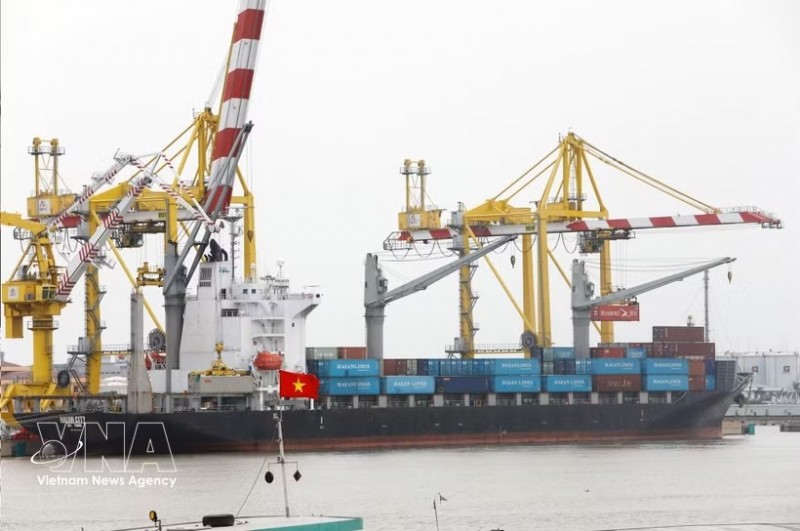 |
| Import and export cargo handled at MPC Port in Hai Phong city. (Photo: VNA) |
There were 43 import items worth more than 1 billion USD each, accounting for 93.9% of total import turnover. Three items exceeded 10 billion USD, making up 55.5%.
Production inputs accounted for 372.04 billion USD, or 94.1%, of the imports. Machinery, equipment, tools and spare parts represented 57.6%, while raw materials, fuels and other inputs made up 36.5%. Consumer goods accounted for 23.26 billion USD, or 5.9%.
The US remained Vietnam’s largest export market, with turnover reaching 122 billion USD in the first eight months, while China was the largest import market with turnover totalling 161.9 billion USD.
To boost exports, NSO General Director Nguyen Thi Huong recommended the Government to effectively implement measures to promote exports and trade, diversify supply and production chains and import-export markets, and improve product quality.
Huong also called for more effective use of opportunities from signed free trade agreements, stronger exports to major markets, and greater access to new and promising markets, including Halal, Latin American and African markets, with a view to achieving a sustainable trade surplus.
Authorities should also provide enterprises with information and support to meet new market standards, assist them in anti-dumping cases, facilitate access to capital, and encourage the application of advanced technologies to improve product quality and value, thereby expanding markets and promoting exports, she added.
Tourism sector serves 6.5 million tourists during National Day holiday
Vietnam's tourism industry served an estimated 6.5 million tourists during the five-day National Day holiday from August 29 to September 2, up 18.1% year-on-year, according to the Vietnam National Authority of Tourism (VNAT).
Major destinations recorded strong increases in tourist arrivals and revenue during the holiday. Ho Chi Minh City welcomed 1.71 million visitors, up 17.8%, generating about 4.9 trillion VND (186 million USD) in tourism revenue. Khanh Hoa received 1.25 million visitors and earned about 2.1 trillion VND, while Hanoi welcomed more than 904,000 visitors, with revenue exceeding 3 trillion VND.
Da Nang recorded 850,000 visitors, up 37%, and tourism revenue of about 3.32 trillion VND. Ninh Binh welcomed nearly 777,000 visitors, up 84.1%, generating more than 1.03 trillion VND. The provinces of Lam Dong, Quang Ninh, An Giang, Lao Cai and Thanh Hoa also posted strong year-on-year growth.
Short, nearby and inter-provincial trips remained popular, with visitors favoring relaxation, nature, cuisine and cultural experiences. Localities and tourism businesses also introduced new products and promotional programmes to attract visitors.
International tourism also recorded positive growth, supporting the outlook for the final months of 2026, particularly from October when many overseas markets enter their peak travel season, cited VNA.
 |
| Tourist arrivals in Hue surge 231% during the National Day holiday. (Photo: VNA) |
Da Nang welcomed more than 224,000 international visitors, while Ninh Binh received nearly 110,000 tourists, up 35.4%. Khanh Hoa recorded about 96,000 overnight international visitors; Hanoi welcomed 94,000 holidaymakers, up 82.4%; Ho Chi Minh City 62,000, up 37.8%; Lao Cai 34,000; and An Giang nearly 27,000, up 68.7%.
Ahead of the holiday, tourism authorities and local administrations stepped up preparations to ensure security, traffic safety and service quality, while strengthening inspections of accommodation, transport and tourism services.
The five-day National Day holiday, the final peak period of Vietnam’s 2026 summer travel season, benefited from generally favorable weather and a wide range of cultural, entertainment and tourism activities across the country.
El Niño strengthens, HCMC could hit 36°C in the middle of rainy season
A strengthening El Niño is expected to bring significantly higher temperatures and lower rainfall to southern Vietnam and Ho Chi Minh City in September 2026, prompting residents to prepare water reserves for daily use and production.
According to Le Manh Dung, a forecaster with the Southern Regional Hydro-Meteorological Center, El Niño continued to intensify sharply in August and is forecast to strengthen further in September 2026.
Under the influence of El Niño, average temperatures across southern Vietnam in September are forecast to be 1-2°C above the long-term average, VNN reported.
 |
| Despite being in the rainy season, Ho Chi Minh City and southern Vietnam could still experience periods of intense heat in September. Photo: Hue Ex |
Daytime highs will generally range from 31-34°C, with some days reaching 35-36°C. The lowest temperatures are expected to range from 25-28°C.
Dong Nai and Ca Mau are forecast to record the largest temperature increases compared with the overall regional average.
In Ho Chi Minh City, average temperatures in September are expected to be around 1-1.5°C above the long-term average. The northwestern part of the city is forecast to be notably hotter, with temperatures 1.5-2°C above normal.
Rainfall declines, strong winds pose risks at sea
Alongside rising temperatures, total rainfall across southern Vietnam in September is expected to be below the long-term average.
In Dong Nai and Ca Mau, rainfall is forecast to fall short of normal levels by around 50-70 millimeters, equivalent to a decline of 10-20%.
In Ho Chi Minh City, the rainfall deficit is generally expected to range from 10-50 millimeters. The city center and northern areas are likely to see the greatest shortfalls, at around 60-80 millimeters, or 5-25% below the long-term average.
Despite the overall decline in rainfall, widespread heavy rain could still occur during the first 15 days of September.
The meteorological agency also warned vessels operating in southern waters during the first half of September to be alert to risks from a strong southwest monsoon.
With rainfall declining and temperatures rising, the regional meteorological agency has advised local authorities and residents to proactively store fresh water. The measure is intended to help meet household, industrial and agricultural irrigation needs and reduce the risk of localized water shortages in the coming period.