
Vietnam Accelerates DNA Collection from Families of Unidentified Fallen Soldiers
 | Comrade's House Presented to the Family of Soldier in Difficult Circumstances |
| Truong Sa Soldiers and People Stand Resolute, Looking Ahead to the 14th National Party Congress |
Providing new grounds for identifying fallen soldiers
According to the Ministry of Public Security’s Electronic Information Portal, for more than half a century, the family of Tran Thi Lan (born in 1951, residing in Loc Ha Commune, Ha Tinh Province) has been unable to locate the grave of her elder brother, martyr Tran Van Dao (from Mai Phu Commune, Ha Tinh Province), who fought on the Southern battlefield and never returned.
Very little information about the fallen soldier remains. His family only knows that he served in the South, but they do not know his military unit or the location where he was killed. Therefore, when officers from Mai Phu Commune Police guided the family through the registration process for DNA sample collection, Lan expressed hope that DNA matching would provide a new opportunity to find her brother’s grave.
Like Lan’s family, many relatives of fallen soldiers across the country are still waiting for accurate information about their loved ones after decades of searching. In this context, the collection of DNA samples from relatives of fallen soldiers is regarded as a practical solution that provides additional scientific data to support efforts to identify the remains of fallen soldiers.
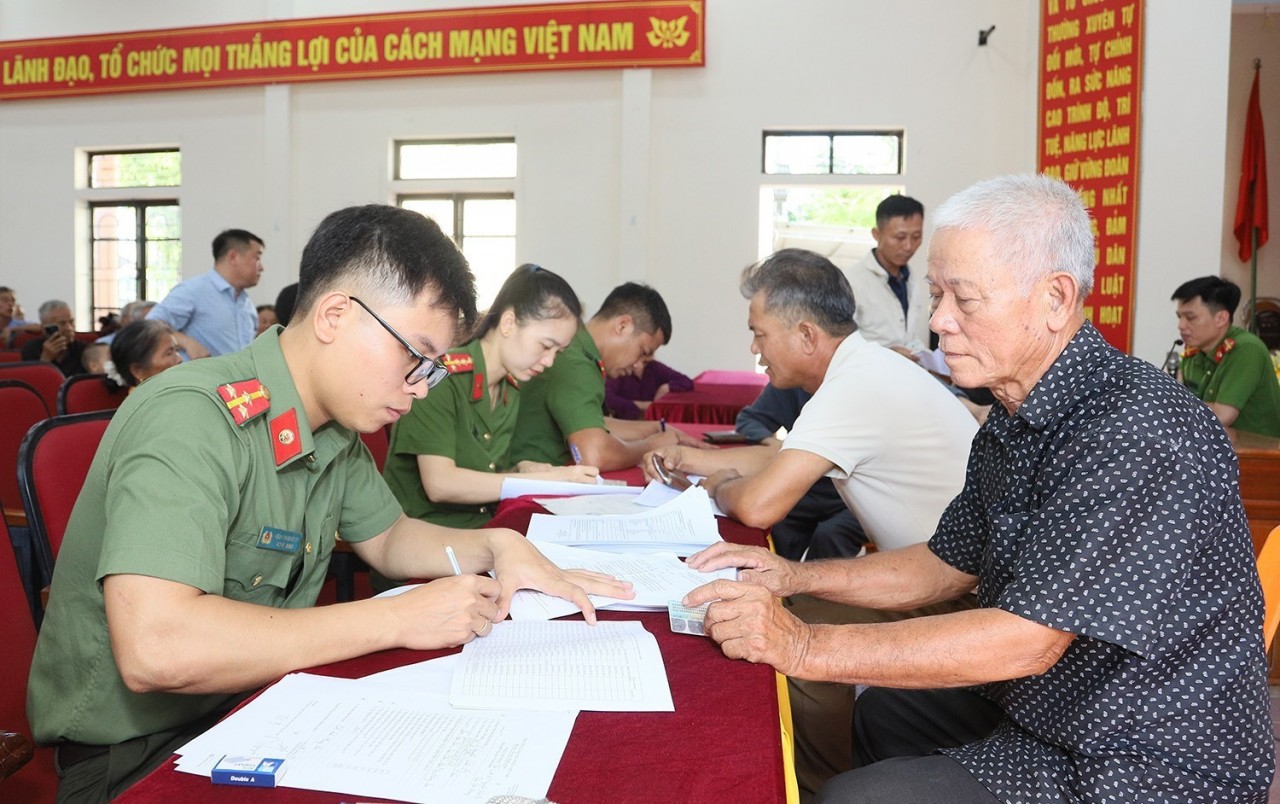 |
| Police forces have intensified communication efforts and provided guidance on DNA sample registration for relatives of fallen soldiers. (Photo: Ministry of Public Security Electronic Information Portal) |
In Ha Tinh Province, commune- and ward-level police are coordinating with local authorities, mass organizations, and grassroots officials to review information on fallen soldiers, assist relatives in completing documentation, establish family lineage charts, and identify eligible individuals for DNA sampling. This work is being carried out in preparation for a large-scale DNA collection campaign scheduled to take place from July 3 to July 7 at five collection clusters across the province.
According to Mai Phu Commune Police, the locality currently has 84 fallen soldiers whose burial information remains unidentified, with 133 relatives eligible for DNA sampling. In Thach Lac Commune, 148 out of a total of 302 fallen soldiers still lack complete grave information. Grassroots police officers are directly assisting families with declarations and verification of genealogical information while also providing support measures for elderly relatives, those in poor health, and individuals facing mobility challenges.
According to the Social Order Administrative Management Police Division of Ha Tinh Provincial Police, information on 22,466 fallen soldiers has been updated in the National Population Database. Of these, 12,241 soldiers still have no grave information; 10,100 have had their grave information identified; and 125 cases have been confirmed as martyr graves no longer containing remains. To date, information on 16,310 relatives of fallen soldiers has been entered into the system to support DNA collection, including 256 DNA samples that have already been collected and uploaded.
The implementation process continues to face numerous challenges. Many fallen soldiers no longer have eligible maternal relatives available for DNA matching; some relatives are elderly and in poor health; and many families have changed their place of residence multiple times over the years. In addition, a considerable number of archived records and documents related to fallen soldiers are incomplete or contain inaccuracies, affecting data collection and verification efforts.
Nationwide peak campaign for DNA collection
The collection of biological DNA samples from relatives of fallen soldiers is being carried out in many localities under the Ministry of Public Security’s plan.
In Lang Son Province, provincial police have coordinated with specialized units of the Ministry of Public Security, grassroots police forces, and sampling teams to collect DNA samples directly from the homes of relatives of fallen soldiers whose graves and identities have not yet been identified. The collection process is conducted in accordance with professional procedures to ensure safety and accuracy. In 2025, Lang Son Provincial Police collected 70 biological DNA samples from relatives of fallen soldiers and updated them in the database for matching purposes.
Meanwhile, An Giang Provincial Police aims to collect more than 3,000 DNA samples from relatives of unidentified fallen soldiers and strives to complete the most comprehensive dataset possible by July 2026.
On June 24 in Hanoi, Deputy Prime Minister Pham Thi Thanh Tra attended the launch ceremony for the nationwide peak campaign to collect biological DNA samples from relatives of fallen soldiers whose information remains unidentified. The initiative is part of the “500 days and nights of accelerated search, recovery, and identification of fallen soldiers’ remains” campaign, marking the lead-up to the 80th anniversary of War Invalids and Martyrs Day (July 27, 1947 - July 27, 2027).
According to information presented at the ceremony, the Ministry of Public Security has recently taken the lead, in coordination with relevant agencies, in collecting, matching, analyzing, and synchronizing more than 53,000 DNA records from relatives of unidentified fallen soldiers into the database. As a result, the identities of 25 previously unidentified fallen soldiers have been confirmed and officially recognized, contributing to improved effectiveness in the identification process.
Quoting Thanh Nien newspaper, Major General Vu Van Tan, Deputy Director of the Department of Social Order Administrative Management Police (C06) under the Ministry of Public Security, stated that the nationwide campaign to search for and identify fallen soldiers’ remains through biotechnology and population data is being implemented at an unprecedented pace across the country.
The campaign has set an ambitious target of collecting 300,000 biological samples during 2026. The roadmap is divided into two phases: Phase 1, from June 25 to July 25, aims to collect 250,000 samples, while Phase 2, from July 26 to December 31, seeks to collect the remaining 50,000 samples.
Currently, more than 175,000 fallen soldiers nationwide have yet to have their remains recovered, while over 300,000 martyr graves still lack complete information. Therefore, the development and completion of a DNA database for relatives of fallen soldiers is considered a crucial foundation for improving the matching and verification of identities, helping fulfill the wishes of policy beneficiary families and further advancing Vietnam’s efforts to honor those who sacrificed for the nation.
 | Fostering Understanding of Peace and Reconciliation Among Future Generations: USABCI President The Vietnam Wartime Accounting Initiative (VWAI) reflects a shared commitment to education, humanitarian action, and post-war reconciliation, according to Margaret Hanson-Muse, President and CEO of ... |
 | Vietnam War Veterans Association Holds Successful 8th National Congress The 8th National Congress of the Vietnam War Veterans' Association for the 2026-2031 term successfully concluded on the afternoon of June 17 in Hanoi, after ... |



Most read

Related Stories
 Viet's Home
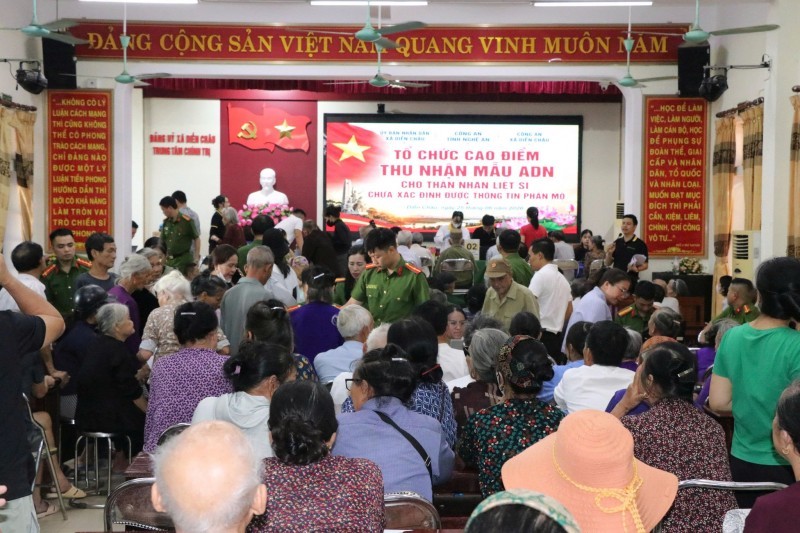
Nghe An's 500-Day and Night Campaign Collects 17,831 DNA Samples
 Viet's Home
More than 1,300 Fallen Soldiers' Remains Recovered After 111 Days of Campaign
 National
500-Day Campaign: Hope of Reunion Through DNA Evidence
 Handbook
Conclusion No. 57-KL/TW: Highest Priority to the Search, Recovery, and Identification of Fallen Soldiers' Remains
Recommended
 Viet's Home
9 Vietnamese Students Receive Full Scholarships from Fast Retailing Foundation in Japan
 Viet's Home
Many Fallen Soldiers' Remains Recovered in Da Nang and Cao Bang
 Viet's Home
Indian Ambassador Thanks Vietnam for Swift Response to Phu Quoc Speedboat Capsizing
 Viet's Home
Portugal Crowned Champion of 2026 Da Nang International Fireworks Festival
Popular article
 Viet's Home
Ca Mau Enhances Capacity of Officials to Effectively Mobilize International Aid
 Viet's Home
Over 50 Calls and Messages Help Search for Fallen Soldiers at Tan Son Nhat Airport
 Viet's Home
Palestinian Ambassador Saadi Salama Awarded "For the Cause of Culture, Sports and Tourism" Medal
 Viet's Home