
OCOP Products Drive New Growth in Vietnam’s Rural Tourism
| Vietnam Emerges as Rising Favorite Among European Travelers to Asia Different Way to Experience Hue |
Bringing dual benefits to rural economy
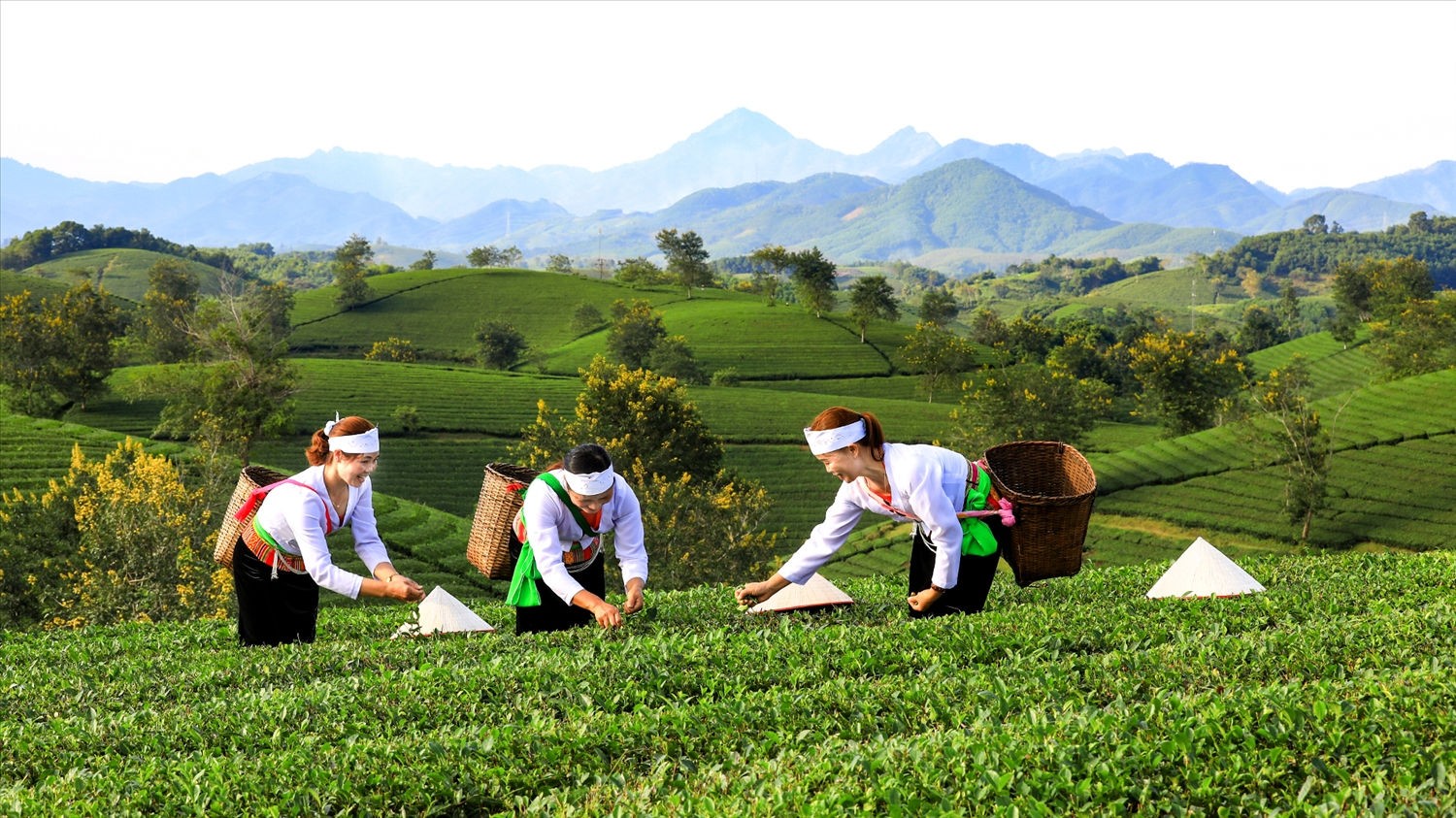 |
| Tourists experience tea picking at Long Coc tea hills in Phu Tho Province. |
According to Ha Van Sieu, Deputy Director General of the Vietnam National Authority of Tourism, developing rural tourism in conjunction with the exploitation of OCOP products and the preservation of cultural values is not only a trend toward sustainable development but also an important task to concretize the Party's orientations and the State's policies.
“This approach brings dual benefits to rural areas: it enhances the value of OCOP products and promotes economic restructuring, while also contributing to the restoration, preservation, and promotion of cultural values and indigenous knowledge. At the same time, it responds to the trend toward green and sustainable tourism and the goal of building new-style rural areas,” said Deputy Director General Ha Van Sieu of the Vietnam National Authority of Tourism.
As part of the National Target Programs, the project “Developing tourism in association with the production and consumption of OCOP products, contributing to the preservation and promotion of cultural values and indigenous knowledge in rural areas of Vietnam” aims to unlock new resources and promote the development of OCOP products through tourism, while creating momentum for the development of craft villages and the rural economy.
Deputy Director General Ha Van Sieu said that implementing the project in practice requires the participation of all stakeholders. Accordingly, businesses play a role in investment, organizing production, and bringing products to the market. Experts support the improvement of development approaches. Artisans and communities are the custodians, creators, and transmitters of cultural values and the stories behind the products.
Meanwhile, management agencies and local authorities play a role in creating a favorable environment, policies, and conditions. Funding organizations and development partners can accompany and support specific projects. The project “Developing tourism in association with the production and consumption of OCOP products, contributing to the preservation and promotion of cultural values and indigenous knowledge in rural areas of Vietnam” needs to become a practical tool for promoting policies, programs, and projects, as well as mobilizing resources for local tourism development.
According to the Vietnam National Authority of Tourism, tourism, OCOP, and culture have a multi-value linkage. To strongly develop rural tourism through the exploitation of OCOP products, specialized solutions are needed for each group of OCOP products. At the same time, comprehensive solutions are required to promote sustainable tourism-OCOP-culture linkages, identify key pillars and implementation roadmaps, and clearly assign responsibilities to ministries, sectors, and localities.
Turning local stories into resources for tourism development
The process of developing the project “Developing tourism in association with the production and consumption of OCOP products, contributing to the preservation and promotion of cultural values and indigenous knowledge in rural areas of Vietnam” places strong emphasis on feasibility and delivering tangible benefits to communities.
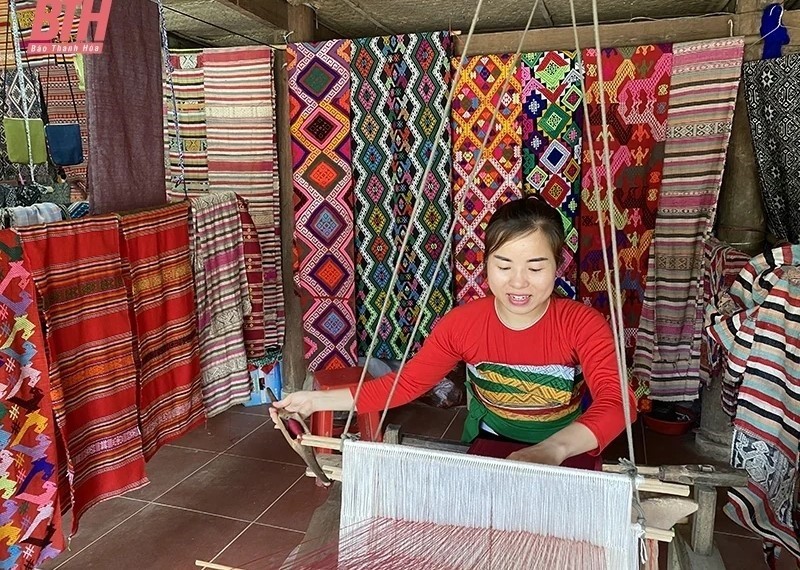 |
| In Pu Luong Commune, Muong Kho brocade weaving is a three-star OCOP product. |
One of the issues emphasized is that OCOP products need to have stories, evoke emotions, and provide experiences for tourists. Localities and OCOP producers need to develop and systematize local stories, while strengthening coordination with cultural experts to create products that not only have material value but can also tell stories about the land, its people, and local culture.
Drawing on practical experience in local development, Van Ba Son, Deputy Director of the Da Nang Department of Culture, Sports and Tourism, said that local stories need to be transformed into resources for tourism development. Storytellers must know how to convey cultural values and folk knowledge through attractive products, while linking products to the market and integrating OCOP products into the tourism service system. In this process, guidance from local authorities and management agencies plays an important role.
According to Associate Professor and PhD Bui Thanh Thuy, Head of the Faculty of Tourism at Hanoi University of Culture, stronger links are needed among communities, artisans, businesses, restaurants, and cultural industry organizations. OCOP products must ensure authenticity and respect for nature.
“Tourism development needs to place communities and artisans at the center, cultural preservation as the foundation, and creativity as the driving force. At the same time, safety, quality, and sustainable development requirements must be ensured,” Associate Professor and PhD Bui Thanh Thuy said.
From another perspective, Associate Professor and PhD Pham Hong Long, Chairman of the Scientific and Training Council of the Faculty of Tourism Studies at the University of Social Sciences and Humanities, Vietnam National University, Hanoi, said that OCOP tourism development should be placed within a complete service supply chain, ranging from food, accommodation, and transportation to recreation, entertainment, and shopping.
“Tourists should not only be taken to visit OCOP sites but also have the opportunity to directly participate in the process of creating products, enjoy them, learn about them, make connections, and purchase products to take home. In particular, digitalization needs to be accelerated and product quality improved to better meet tourists’ needs,” Associate Professor and PhD Pham Hong Long added.
 OCOP Vietnamese Shrimp Paste Exported to Japan and Australia OCOP Vietnamese Shrimp Paste Exported to Japan and Australia For a long time, shrimp paste (mam tom) has been the proide of Vietnamese people. Now that it has become an OCOP product, shrimp paste is exported to Japan, Australia, or the US. |
 Vietnam's One-of-a-Kind Products Drive Tourism Vietnam's One-of-a-Kind Products Drive Tourism Vietnam's tourism industry focuses on professionalism, strengthening regional connectivity, and integrate with other sectors in the development chain, especially building unique products tied to local culture. |


Related Stories
 Travel
Viet Nam Promotes Tourism in Hungary
 Travel
Phu Quoc Tops Asia’s Most Beloved Islands List for 2026
 Travel
Routard (France) Hails Ha Long Bay’s Timeless Beauty
 Travel
Viet Nam Welcomes More Than 17.7 Million International Visitors in First Nine Months
Recommended
 Travel
Viet Nam Promotes Tourism at Warsaw International Travel Fair (Poland)
 Travel
Viet Nam, Austria Boost Tourism Cooperation and Destination Connectivity
 Travel
A Colorful Celebration of South Korea and Vietnam Cultures in Phu Quoc
 Travel
Turning Vietnamese Cuisine into Tourism Asset
Popular article
 Travel
Explore Central Vietnam Aboard the Hue-Phong Nha Heritage Train
 Travel
Vietnam Leads World's Top Culinary Destinations
 Travel
Hue and Da Nang Offer Free Admission at Numerous Attractions for National Day
 Travel