
The 500-Day-and-Night Campaign: Peacetime Mission to Search for and Identify Fallen Soldiers
| 500-Day-and-Night Campaign: 1,863 Martyrs’ Remains Recovered, Identification Efforts Accelerated 500-Day Campaign: 28 Martyrs’ Remains Repatriated from Two Lao Provinces |
Searching the battlefields, reconstructing the past
The area of Le Thi Rieng Park was once associated with battles during the General Offensive and Uprising of Spring 1968. After several decades, the terrain has changed significantly. Therefore, identifying locations and organizing searches must draw on multiple sources of information.
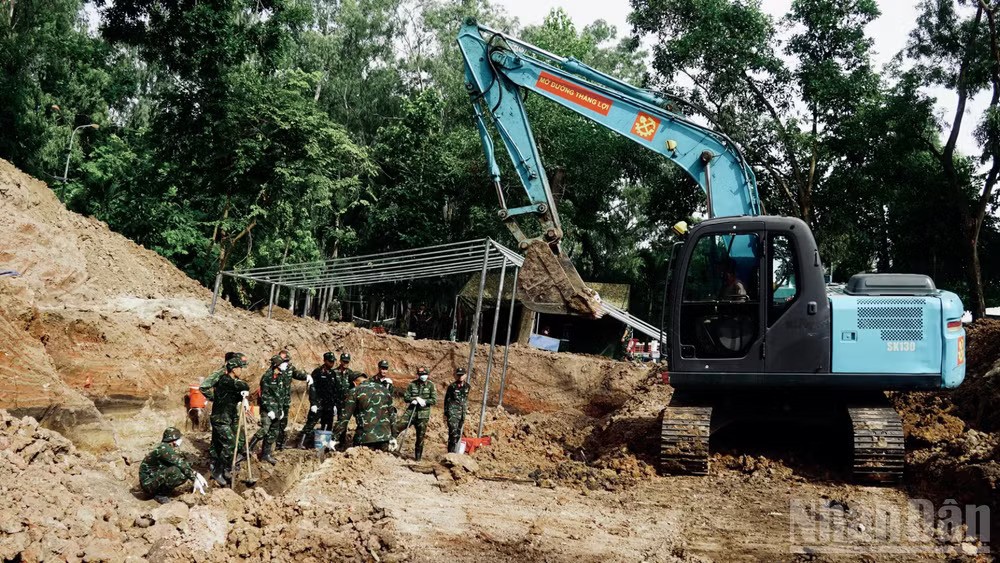 |
| Search and recovery of fallen soldiers’ remains in Area B of Le Thi Rieng Park. (Photo: Le Thanh) |
Historical records, military documents, maps, archival photographs, witness accounts and information provided by local residents have been combined to gradually narrow down the search areas. Once remains are discovered, the accompanying artifacts continue to serve as sources of information for verification.
From June 23 through August 28, a total of 510 sets of remains of fallen soldiers had been discovered and recovered at Le Thi Rieng Park, including more than 250 sets accompanied by artifacts.
This reality shows that, in cases that cannot be identified through DNA alone, an evidence-based approach that combines and cross-checks records, witness accounts, artifacts and other sources of information continues to play an important role.
The “500-day-and-night campaign to intensify the search, recovery and identification of fallen soldiers’ remains” runs from March 15, 2026, to July 27, 2027, marking the 80th anniversary of War Invalids and Martyrs’ Day.
The campaign aims to search for and recover approximately 7,000 sets of fallen soldiers’ remains; collect samples from around 230,000 unidentified martyrs’ graves; conduct DNA testing on approximately 18,000 samples of fallen soldiers’ remains; build and complete a genetic database of relatives; and accelerate bomb and unexploded ordnance clearance in key areas.
As of August 28, the forces involved had searched for and recovered 2,003 sets of fallen soldiers’ remains. Of these, 979 were found in Vietnam, 174 in Laos and 850 in Cambodia.
Results have been recorded in many localities. In Dong Thap, for example, Team K91 recovered 42 sets of fallen soldiers’ remains from a coconut garden belonging to a local household in Ca Cai Hamlet, Tan Thanh Commune. Information provided by local residents was among the sources that helped the authorities identify the search site.
In other areas, reviews have continued in locations where information about martyrs’ graves has been reported. Information from war veterans, witnesses and local residents has been cross-checked against records and archival documents to narrow down the search areas.
The initial results show that the Campaign has been implemented on a broad scale, with the participation of military and police agencies, the home affairs sector, scientific agencies, local authorities and the people.
As of August 28, authorities had collected samples from 164,798 martyrs’ graves. They had also collected 265,761 biological samples from martyrs’ relatives for identification and forensic testing. Of these, 71,102 samples from martyrs’ relatives had been analyzed. A total of 66,909 samples had been synchronized with the database.
This data enables comparisons between unidentified remains and biological samples from relatives.
Combining science, technology and memory
Scientific agencies continue to study suitable methods for difficult samples. The Vietnam Academy of Science and Technology has tested NGS-SNP technology. The technology combines next-generation gene sequencing with single-nucleotide polymorphism analysis. It offers additional identification possibilities for remains of limited quality.
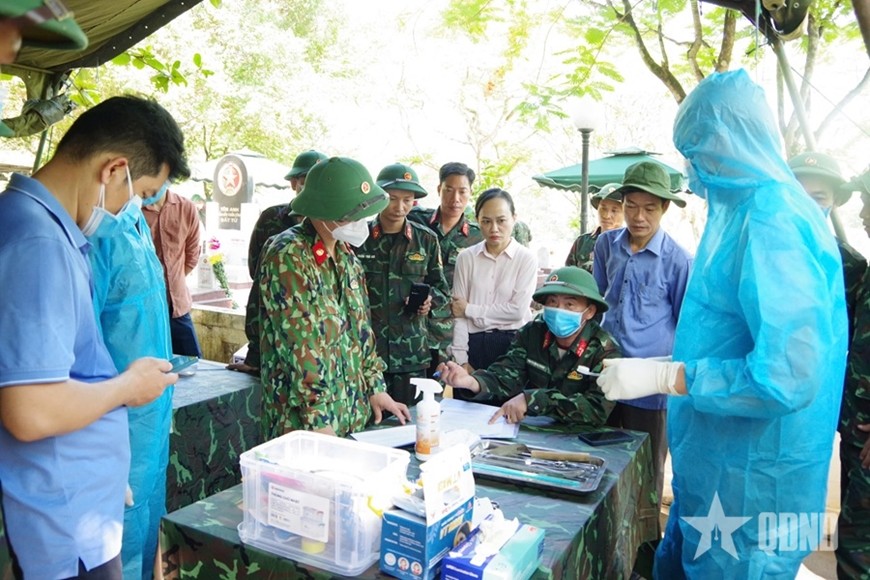 |
| Team 584 of the Quang Tri Provincial Military Command collects samples from the remains of fallen soldiers at Truong Son National Martyrs’ Cemetery. (Photo: QDND) |
However, not every case can be resolved through DNA. After many decades, remains may have deteriorated. They may no longer be suitable for analysis. In such cases, records, witnesses, artifacts and historical data become important sources of evidence.
The Campaign combines technology with traditional verification methods. This creates a continuous process from field searches to identity verification.
Clearance efforts have also been stepped up in key areas. To date, authorities have cleared 12,744.2 of 22,725 hectares. This represents 56.08% of the target. In the core area of Vi Xuyen, Tuyen Quang, 4,162.2 of 4,460 hectares have been cleared. This represents 93.32% of the target.
Another information channel remains the “500-day-and-night campaign” hotline. It receives information from relatives, war veterans and local residents.
Since June 15, the hotline has received around 40,000 calls. More than 13,000 calls came from relatives seeking information about martyrs’ graves. Around 1,800 calls provided information about the burial sites of fallen soldiers.
These figures show that society remains a major source of information. A memory held by a former combatant, an old place name or information preserved by a family can all become leads for a search.
From one soldier returning home after 58 years of waiting to thousands of remains recovered from former battlefields, the 500-day-and-night campaign is broadening the approach to post-war tasks.
It is not merely a search beneath the ground. It is also a process of reconstructing wartime memories through records, witnesses, maps and artifacts. It involves building databases on fallen soldiers and their relatives. It also involves collecting samples, conducting DNA testing and applying new scientific techniques.
As of August 28, more than 2,000 sets of fallen soldiers’ remains had been searched for and recovered. However, this is only an initial result in a long journey. For each family, identifying a fallen soldier provides an answer. It comes after years, even decades, of waiting. For the nation, it is a responsibility to those who sacrificed their lives for independence, freedom and the reunification of the Fatherland.
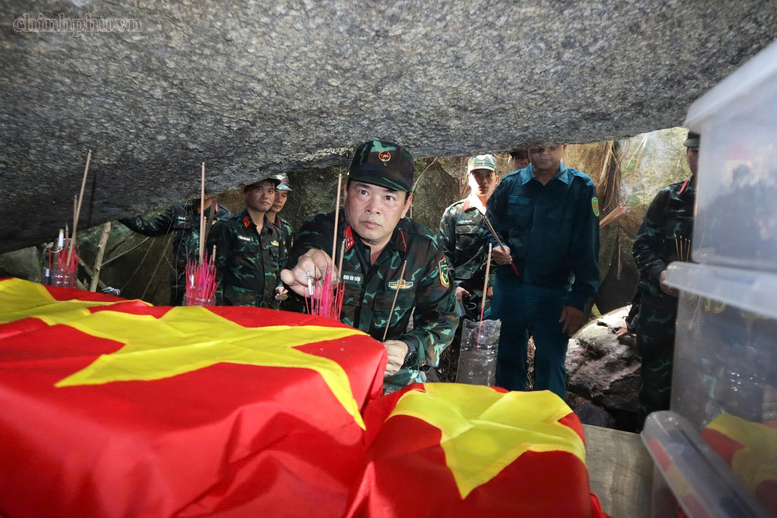 Nearly 40,000 Phone Calls Are Made To “500-day Campaign” Hotline Nearly 40,000 Phone Calls Are Made To “500-day Campaign” Hotline From June 15 to August 12, 2026, the “500-day campaign” hotline received 39,600 phone calls, including more than 13,000 phone calls made by martyrs’ relatives who demanded to search for graves and around 1,800 phone calls to provide information about martyrs’ burial places. |
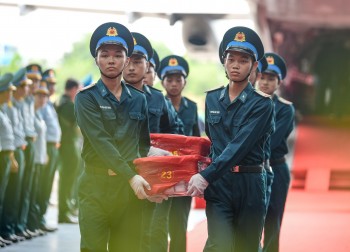 500-Day-and-Night Campaign: 1,863 Martyrs’ Remains Recovered, Identification Efforts Accelerated 500-Day-and-Night Campaign: 1,863 Martyrs’ Remains Recovered, Identification Efforts Accelerated After the launch of the 500-Day-and-Night Campaign to intensify the search for, recovery of, and identification of martyrs’ remains, as of August 22, the forces involved had recovered 1,863 sets of martyrs’ remains. Of these, 839 were found in Vietnam, 174 in Laos, and 850 in Cambodia. |


Most read


Related Stories
 Viets Home
Eight Additional Remains of Fallen Soldiers Discovered at Le Thi Rieng Park
 National
15,401 Fallen Soldiers’ Remains Samples Transported by Military Aircraft
 National
Efforts to Bring Fallen Soldiers Home to Their Families
 Viets Home
500-Day Campaign: 2,803 Martyrs’ Remains Recovered
Recommended
 Viets Home
Vietnamese and RoK Doctors Provide Free Surgery for Children with Birth Defects in HCMC
 Viets Home
Inspired by Her Father’s Words, Do Thi Hue Has Spent 15 Years Empowering People with Disabilities
 Expats in Vietnam
Returning to Viet Nam Is Like Coming Home
 Viets Home
UAE Culture Comes Alive in Hanoi
Popular article
 Viets Home
WVI and Dien Bien Chart Next Chapter in Support for Children
 Viets Home
Tuyen Quang: New Space for Reading, Experiential Learning and Career Guidance for Kim Xuyen Students
 Viets Home
Finding Confidence in Learning English
 Viets Home